How to Price Your Artwork
How to build a consistent pricing structure, set your first prices, and adjust them as your market develops.
John Beckley · 17 min read ·
Contents
- Artwork Pricing: Why No Formula Can Give You the Whole Answer
- Why Build a Consistent Pricing Structure for Your Paintings?
- The French Point Method vs. Square-Inch Pricing
- Khroma 2026 Pricing Calibration: Benchmarks for Painters
- U.S. Square-Inch Pricing Benchmarks
- Why the “Average Price of a Painting” Is Not Very Useful
- In Practice: Which Pricing Reference Should You Use?
- How Your Sales Should Change the Way You Price Your Work
- When and How Should You Raise Your Art Prices?
- A Pricing Structure Is Not a Prison
- Commissions Can Completely Change the Equation
- How to Set the Price of Your Next Painting
- The Khroma Artwork Price Calculator
- The Main Idea to Remember
- Frequently Asked Questions
- Sources and Methodology

How much is my painting worth?
That was one of the first questions I asked myself when I started selling my work. And at the time, I had absolutely no idea how to answer it.
So I did what seemed most logical: I asked other artists how they priced their work. I assumed that people who had already been through the process would be able to give me a few useful reference points.
The answers were… let’s say, pretty rare.
Maybe the subject felt too personal. Maybe everyone had developed their own way of doing things.
Either way, I was left with the same question I had started with. So eventually, I came up with my own formula.
More than twenty years and several thousand original works sold later, I still use a pricing structure. But I’ve also learned something I didn’t understand at all when I started:
A formula will never tell you what your art is worth.
What it can do is help you build something extremely useful: consistent prices.
And once you begin selling regularly, another piece of information gradually becomes more valuable than any generic formula:
your own market.
That’s what we’re going to look at in this guide.
I’ll focus mainly on painting because that’s my field, and most of the pricing methods discussed here are designed primarily for painters. But many of the underlying principles — consistency, sales history, demand, commissions — apply well beyond painting.
Artwork Pricing: Why No Formula Can Give You the Whole Answer
When you search for ways to price artwork, you quickly run into formulas.
One of the most common methods is to add the cost of materials to the number of hours worked multiplied by an hourly rate.
On paper, that makes sense.
And that calculation can absolutely be useful for understanding your costs and making sure you aren’t selling at a loss.
But when it comes to pricing a work of art, a large part of the equation is still missing.
Two artists can create two paintings of the same size, use similar materials, and spend roughly the same amount of time on them without being able to sell those works at the same price.
The artist’s career matters.
So does their sales history.
Their visibility, exhibitions, gallery representation, collector base, and — more simply — the amount of demand they’ve managed to build around their work all play a role.
Even the amount of time spent creating a painting is less straightforward than it seems.
I personally work fairly quickly.
If I finish what I consider one of my strongest paintings in four hours, I see no reason why it should automatically be worth five times less than a painting that took me twenty hours.
The reverse is also true.
Spending an enormous amount of time on a piece does not guarantee that someone will want to buy it at a higher price.
Your time obviously has an economic value.
But time alone is not enough to determine the price of an artwork.
That’s also reflected in guidance from the New York Foundation for the Arts (NYFA). Rather than looking for a universal formula, NYFA recommends comparing your work with artists who are genuinely similar in medium, size, type of work, and — importantly — career stage.
So the question isn’t only:
“How much did this painting cost me to make?”
You also need to ask:
“Where does my work currently sit within its market?”
And when you’re just starting out, a pricing structure can help you answer that question without reinventing your prices every time you finish a new canvas.
Why Build a Consistent Pricing Structure for Your Paintings?
Imagine you have three paintings from the same body of work:
a 20 × 20 in painting at $900;
a 24 × 24 in painting at $750;
a 32 × 32 in painting at $2,400.
You may have an excellent reason for each price.
The problem is that someone discovering your work doesn’t necessarily know what that reason is.
From their perspective, the pricing may simply look difficult to understand.
That’s where a price structure becomes useful.
It creates a logical relationship between different sizes and, just as importantly, saves you from standing in front of every new painting wondering:
“Okay… what should I charge for this one?”
This need for consistency isn’t just a personal preference.
University of the Arts London recommends building a rational pricing structure based on factors such as size, medium, and edition, then keeping that structure reasonably consistent.
When I started, I knew none of this.
So I created my own formula based on the surface area of the painting:
width × height × coefficient
I work in centimeters because I live and work in France.
I’ve used the same basic formula from the beginning.
What has changed over the years is simply the coefficient.
Today, I use 0.17.
For an 80 × 80 cm painting:
80 × 80 × 0.17 = €1,088
For a 100 × 100 cm painting:
100 × 100 × 0.17 = €1,700

When I started out, my coefficient was much lower.
I gradually raised it as my prices and market developed.
I’m not sharing this because I think you should use 0.17.
That number belongs to my own market today.
What matters is what the formula gives me: a reference point.
Two comparable paintings of the same size will normally stay within the same price range. A larger work will generally cost more than a smaller one. And I don’t have to rethink my entire pricing strategy every time I finish a painting.
That’s exactly what a price structure is supposed to do.
It isn’t there to measure your talent. It’s there to organize your prices.
The French Point Method vs. Square-Inch Pricing
There are several ways for painters to create that consistency.
Two are particularly useful to understand.
The French point method
In France, traditional canvas sizes are assigned numbers — 6, 8, 10, 20, 30, 50, and so on.
Artists can assign a monetary value to each “point.”
The formula is simple:
price = canvas format number × value per point
If your point is worth €30 and the canvas is a size 20:
20 × €30 = €600
Simple enough.
But then comes the important question:
Why €30?
Why not €15?
€50?
€100?
And this is where pricing formulas often become much less helpful than they initially appear.
There is no official scale saying that an artist with five years of experience should automatically charge a certain amount per point.
The value of a point is not an official market rating.
It’s mainly a practical convention that helps artists maintain consistency across standard canvas sizes.
Pricing by surface area
You can also ignore traditional canvas formats entirely and calculate directly from the dimensions.
That’s what I do with my own formula.
In the United States, a common version of this approach is square-inch pricing:
width × height in inches × price per square inch
Take a 16 × 20 inch painting.
Its surface area is:
16 × 20 = 320 square inches
At $2 per square inch:
320 × $2 = $640
Again, the calculation itself is easy.
The difficult part is choosing the number.
Why $2 per square inch?
Why not $0.75?
$4?
$8?
Whether you use €30 per point, $2 per square inch, or my own coefficient of 0.17, you eventually arrive at the same underlying question:
How did you decide what that number should be?
That was one of the hardest questions we had to answer when we built the Khroma Artwork Price Calculator.
Khroma 2026 Pricing Calibration: Benchmarks for Painters
When we started working on the Khroma calculator, we quickly noticed something frustrating.
There is a huge amount of advice online about how to price paintings.
There are also a lot of numbers.
But when you try to understand where those numbers actually came from, things often become much less clear.
So we decided to conduct our own research.
The goal was not to create a “Khroma rating” or pretend that a questionnaire could determine the true value of an artist.
We were trying to answer a much more modest — and much more useful — question:
What is a reasonable starting price for an artist who does not yet have enough sales history to build a reliable pricing structure of their own?
What we looked at
We deliberately did not calculate one giant average from every painting we could find online.
That would have been easy.
And probably not very useful.
On an open marketplace, a small original may be listed for a few dozen dollars.
A professional emerging artist might ask several hundred dollars for a comparable size.
An artist with an established collector base may ask several thousand.
Mixing all of those together produces an average that may represent almost nobody.
So we separated different market environments:
highly open marketplaces and direct selling;
selected exhibitions and art fairs;
curated platforms and galleries;
artists at different visible stages of career and demand.
We then compared factors such as dimensions, medium, visible career history, and asking price.
An important limitation
It’s essential to understand what this research measures — and what it does not.
Most publicly accessible prices are asking prices.
They are not necessarily the prices at which the artwork ultimately sells.
On some platforms, negotiation is explicitly possible.
So the Khroma calibration is designed to help establish a reasonable listing price.
It is not a secondary-market valuation.
It is not an appraisal.
And it is not an official artist rating.
U.S. Square-Inch Pricing Benchmarks
For the U.S. version of the Khroma calculator, we use square-inch pricing because it fits American canvas sizes and pricing habits much better than the French point system.
Our current starting ranges are:
Artist situationSuggested starting range | |
Complete beginner | $0.50–$1.00 / sq in |
First sales | $0.75–$1.50 / sq in |
Structured emerging artist | $1.50–$2.75 / sq in |
Established regional / mid-career artist | $2.75–$4.50 / sq in |
Confirmed / collected artist | $4.00–$8.00 / sq in |
We also apply a minimum price floor of $150 so that very small formats do not produce unrealistically low prices.
These ranges overlap intentionally.
The real world does not divide artists into five perfectly separate boxes.
Someone may have been painting for ten years and barely sold anything.
Another artist may have been working for a much shorter period but already have regular sales, exhibitions, repeat buyers, and genuine collector demand.
That’s why I find it much more useful to look at what actually happened during those years than simply count them.
Years alone do not create a market.
What about the medium?
Medium can influence pricing, but I would be very careful about turning technique adjustments into rigid rules.
The U.S. Khroma calculator uses acrylic as its reference medium and adjusts from there depending on the technique.
But one of the broader lessons from our research is that the artist, their track record, and demand for the work often matter much more than whether the painting is acrylic or oil.
A strong market can easily override a generic medium multiplier.
That’s exactly how these benchmarks should be understood:
They are useful when you do not yet have better information. They should never replace better information once you have it.
Why the “Average Price of a Painting” Is Not Very Useful
The price differences we found across the market were enormous.
On highly open marketplaces, you can find small originals listed for only a few dozen dollars.
On more selective platforms or through established artists, paintings of comparable size may be listed for hundreds or thousands.
The same issue appears in France.
During our calibration, for example, we looked at several paintings measuring 73 × 60 cm, a standardized French 20F format — roughly 28.7 × 23.6 inches.
Examples we observed on Artsper included works listed around:
€1,200;
€1,400;
€4,300.
Using the French point method, those correspond to approximately:
€60 per point;
€70 per point;
€215 per point.
At the other end of the market, a selected small-format exhibition in France set a fixed selling price of €90 per original artwork.
All of those prices are real.
They are not necessarily contradictory.
They simply belong to different artists, different career stages, and different markets.
That’s why I’m very cautious about questions like:
“What is the average price of a painting this size?”
A much more useful question is:
“Where does my work currently belong within this market?”
In Practice: Which Pricing Reference Should You Use?
The logic can be summarized fairly simply.
You have never sold an artwork
→ Use a starting structure and genuinely comparable artists.
You have made a few sales
→ Start giving your own sales history more weight.
You sell regularly
→ Your own market should become your primary reference.
Demand is higher than what you can produce
→ It may be time to consider gradually increasing your prices.
And this may be the most important principle in this entire guide:
The stronger your real sales history becomes, the less a generic pricing formula should be making decisions for you.
How Your Sales Should Change the Way You Price Your Work
When you’re starting out, you don’t yet know what buyers are actually willing to pay for your work.
So you have to look outward.
You use comparable artists, market ranges, your career stage, your medium — whatever helps you avoid choosing a number completely at random.
But once your first sales start happening, the situation changes.
Imagine you sell three or four similar paintings around $500.
That number becomes interesting.
It does not prove that every future painting you make is worth exactly $500.
But several people have now independently decided that your work was worth that amount to them.
That is already far more useful than a generic recommendation from an article online.
Now imagine that a few years later you have sold twenty comparable paintings between $900 and $1,100.
At that point, if a generic pricing formula tells you those works should be priced at $600, I don’t see much reason to listen to it.
You have something better:
your own sales history.
NYFA likewise recommends using previous sales as a reference when that information exists and allowing prices to increase gradually as real signals develop.
What happens when demand exceeds what you can produce?
That changes things again.
If new paintings consistently sell very quickly, collectors are waiting for your next release, or you simply have more potential buyers than available work, your market is giving you another useful signal.
You already know your prices work.
The question becomes whether they may now be too low relative to demand.
That is one of the clearest situations in which a gradual price increase can make sense.
When and How Should You Raise Your Art Prices?
My own prices developed in a similar way, even though I obviously wasn’t thinking in terms of “market signals” when I started.
My earliest paintings sold for around €100.
Then my prices moved fairly quickly into the €300–€400 range, with some auctions going higher.
I never woke up one morning and thought:
“I’ve sold twenty paintings. Tomorrow I’m raising everything by 10%.”
It happened much more naturally.
My work was developing, sales continued, my experience increased, and from time to time it simply made sense to raise my coefficient.
University of the Arts London recommends a similar approach: let price increases follow things that can actually be observed — sales, exposure, and changes in demand — rather than raising prices mechanically because another year has passed.
Signals I would personally pay attention to include:
increasingly consistent sales;
how quickly certain works sell;
repeat collectors;
increasing visibility;
changes in representation;
demand beginning to exceed your available work.
On the other hand, if nothing is selling, your pricing deserves to be looked at.
But I would not automatically conclude that the solution is to lower it.
If nobody is seeing your work, cutting the price in half may change nothing.
The real problem may be visibility, photography, audience, sales channel, or simply how the work is being presented.
Price matters a lot. But it doesn’t explain everything.
A Pricing Structure Is Not a Prison
There is a limit to all this emphasis on consistency.
Two artworks with the same dimensions are not always truly comparable.
From time to time, for example, I paint realistic oil portraits.
I do it simply because I enjoy returning to that kind of painting occasionally.
The process has almost nothing in common with my usual production.
I may spend around two weeks working on one of those portraits.
In that situation, I’m obviously not going to feel obligated to sell it for exactly the same amount as another painting of the same dimensions made using a completely different process.
I would probably price it significantly higher.
That does not mean I suddenly start charging by the hour.
It simply means that this particular work sits outside my usual body of work, so my normal pricing structure is no longer the right comparison.
I think that’s a useful way to look at it:
A pricing structure is designed to compare things that are actually comparable.
A particularly complex piece, a major work, an unusual process, or something that genuinely falls outside the rest of your production may justify a different price.
The important thing is not to turn every painting into an exception.
Otherwise, you end up right back where you started.
Commissions Can Completely Change the Equation
There is another issue artists don’t always think about enough when setting their first prices.
The price the buyer sees is not necessarily the amount you keep.
A painting sold for $1,000 does not automatically put $1,000 in your pocket.
Depending on how you sell, you may need to account for:
materials;
framing;
payment processing;
packaging;
shipping expenses;
taxes;
business costs;
and, of course, commissions.
Those commissions can be substantial.
The New York Foundation for the Arts notes that gallery commissions commonly fall in the 40% to 60% range.
The College Art Association likewise discusses a typical gallery commission of around 50%, while emphasizing that terms and responsibilities should be clearly defined between artist and gallery.
Take a very simple example.
Your painting is listed at:
$600
With a 30% commission, you keep:
$420 before your other costs and taxes.
With a 50% commission:
$300.
The math isn’t exciting.
But it’s much better to do it before accepting a sales arrangement than after your first sale.
Should you charge different prices depending on where the artwork is sold?
It’s tempting.
You might think about listing the same painting at $600 on your own website, $850 on a marketplace, and $1,200 through a gallery so that your net income ends up roughly the same.
Personally, I don’t like that approach very much.
From the buyer’s point of view, you are giving the exact same artwork several different values.
And if someone discovers that they can buy directly from you for dramatically less than the gallery that is trying to build your market, the relationship becomes difficult to sustain.
NYFA also recommends maintaining consistent retail pricing across sales channels.
I prefer to think in terms of one coherent public price, then evaluate what each sales channel provides in return for its commission.
A gallery may charge a significant commission but organize exhibitions, introduce your work to collectors, communicate actively, advise clients, and actually make sales.
That can provide a great deal of value.
On the other hand, a lower commission is not automatically a better deal if the channel brings you neither visibility nor buyers.
The percentage matters, of course.
But what you receive in return matters just as much.
How to Set the Price of Your Next Painting
If I had to start again from zero today, I would not spend weeks searching for the perfect price.
I would begin by choosing a simple method.
In the U.S., square-inch pricing is an obvious starting point for many painters.
Then I would look for a handful of genuinely comparable artists.
Not the cheapest painting I could find online.
And not an artist who has been represented by major galleries for thirty years.
I would look for artists whose medium, dimensions, career stage, and market reasonably resemble my own.
From there, I would choose an initial price per square inch and calculate several sizes at once.
That part is important.
Don’t calculate only the price of the painting you just finished.
Calculate five.
Ten.
Fifteen.
You will quickly see whether your system still makes sense as the dimensions change.
I would then test the structure against several commission scenarios.
For example:
0%;
30%;
50%.
And after all that…
I would start selling.
Because you can spend six months studying other artists’ prices, building incredibly sophisticated spreadsheets, and adjusting your rate down to the last cent.
Until somebody actually buys, part of the reasoning is still theoretical.
The first sale gives you information.
The second gives you a little more.
And eventually, the picture starts becoming much clearer.
The Khroma Artwork Price Calculator
We created the Khroma Artwork Price Calculator to help painters during that first stage — when they do not yet have enough personal data to rely on.
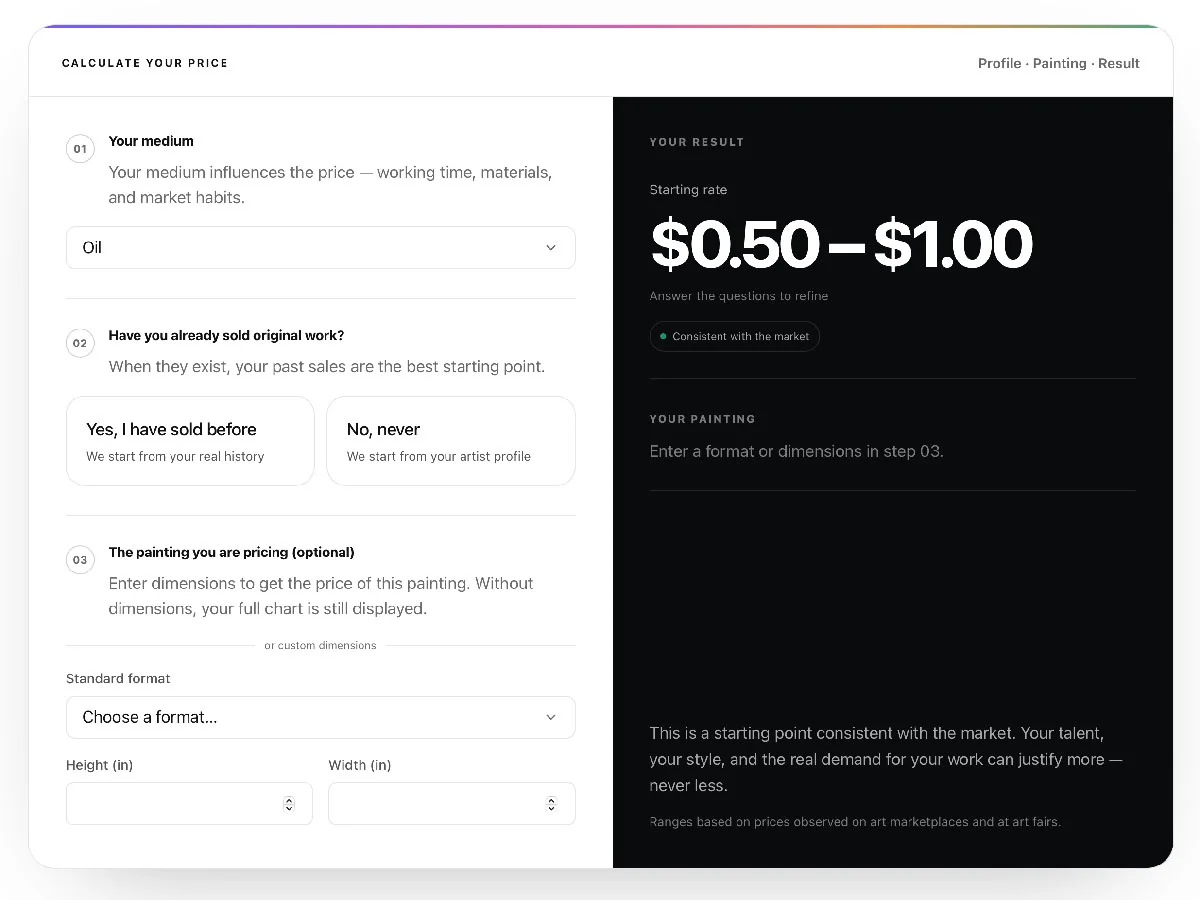
The French version uses the traditional point method.
The U.S. version works differently and uses square-inch pricing, making it much better suited to American canvas sizes and pricing habits.
It takes into account factors such as:
medium;
artist profile;
career stage;
and, when available, actual sales history.
The ranges used by the calculator come directly from the market calibration discussed in this guide.
Its purpose is not to answer:
“How much is my art worth?”
I don’t think a calculator can seriously answer that question.
We are trying to answer something much more practical:
“At what level can I reasonably start building my pricing structure?”
If you have never sold anything, the calculator can give you an initial reference point.
If you have started making sales, your own history should gradually become part of the equation.
And if you have been selling consistently for years and understand your market very well, you probably need our calculator less.
That’s exactly how it should work.
It has simply done its job.
Try the Khroma Artwork Price Calculator
The Main Idea to Remember
When I started painting, I was mainly looking for a formula that would give me the correct answer.
Looking back, I think I was asking the wrong question.
A formula cannot know how much your work is worth.
What it can do is stop you from pricing everything completely at random.
You first build a structure.
Then you put that structure in front of the market.
And gradually, your own sales begin replacing assumptions with real information.
Your prices evolve along with them.
A good price is not a number you discover once and keep forever. It is something you build, test, and adjust over time.
Frequently Asked Questions
Is there an official price-per-square-inch rate for artists?
No.
There is no official or regulated price-per-square-inch rate for artists.
It is simply a practical way to create consistency between different canvas sizes.
Once you have enough real sales history, your own market becomes a much more useful reference than a generic square-inch rate.
How should I price my paintings if I have never sold any before?
If you have never sold, you have to begin with assumptions.
Start with a reasonable pricing structure based on size, medium, career stage, and a few genuinely comparable artists.
The goal is not to discover the perfect price immediately.
The goal is to establish a sensible starting point that you can then test against the market.
Should I price a painting based on how many hours it took?
The amount of time you spend matters when evaluating whether your practice is economically sustainable.
But it is not enough by itself to determine the selling price of an artwork.
A painting completed quickly can be excellent and highly desirable.
A painting that took several weeks does not automatically have a buyer willing to pay more for it.
When should an artist raise their prices?
A price increase becomes easier to justify when sales become consistent, collectors return, works begin selling quickly, or demand starts exceeding the amount of work you can produce.
In general, gradual increases based on real market signals make more sense than large automatic increases simply because another year has passed.
Should the same artwork cost the same on my website, in a gallery, and on a marketplace?
In most cases, maintaining a consistent public retail price is the cleaner approach.
Commissions and services can vary dramatically between sales channels, but offering the exact same artwork much cheaper elsewhere can confuse collectors and create problems with galleries or other partners.
Sources and Methodology
The Khroma 2026 Pricing Calibration was built from publicly listed prices across several segments of the art market, including open marketplaces, direct sales, selected exhibitions, specialized platforms, and galleries.
Those observations were supplemented with professional and educational guidance on artwork pricing.
The prices observed are primarily asking prices, not necessarily completed transaction prices.
The ranges in this guide should therefore be treated as positioning benchmarks for setting a listing price, not as an appraisal, formal artist rating, or estimate of secondary-market value.
Professional and Institutional Sources
University of the Arts London (UAL) — 5 Steps to Building a Professional Life for Your Art
College Art Association (CAA) — Professional Practices for Artists
Market Observations Used in the Calibration
The research included listed prices from markets and platforms such as Etsy, Artsper, Rise Art/KAZoART, and Singulart, along with selected galleries, exhibitions, and other direct-market references.
References include:
Artsper — contemporary paintings and current listed prices
Artsper — example of a 73 × 60 cm painting listed around €1,200
Artsper — Sophie Dumont, Conversation, 73 × 60 cm, listed at €4,300
Rise Art
Singulart
Etsy
Villa Frouin 2026 Small Format Exhibition — France
These individual listings do not constitute the calibration on their own.
Their purpose is to illustrate just how wide the pricing range can be — and why the same size painting can reasonably carry very different prices depending on the artist and the market around their work.
Read next
Sell Your Art Online: The Complete Guide for Artists
After twenty years and roughly 3,700 artworks sold, I share what I’ve learned about selling art online: pricing your work, choosing where to sell, finding buyers, presenting your art, and shipping it.
Khroma ·
Khroma launches its blog
Guides, insights and resources for artists and collectors, covering art, visibility, selling, collecting and the evolution of Khroma.