Where to Sell Your Art Online?
I started selling my paintings on eBay in 2005, before my own website became my main sales channel. Here's what I've learned about social media, art marketplaces, and online galleries—and why I believe every artist should have a website of their own.
John Beckley · 16 min read ·
Contents
- Why I Believe Every Artist Needs Their Own Website
- Social Media: Getting Your Work Seen and Finding Your First Buyers
- Marketplaces and Online Art Galleries: Reaching New Collectors
- Selling in Multiple Places: A Good Idea, but Watch the Workload
- Khroma: A Ready-to-Use Artist Website, Plus an Online Gallery
- So, Where Should You Sell Your Art When You're Starting Out?
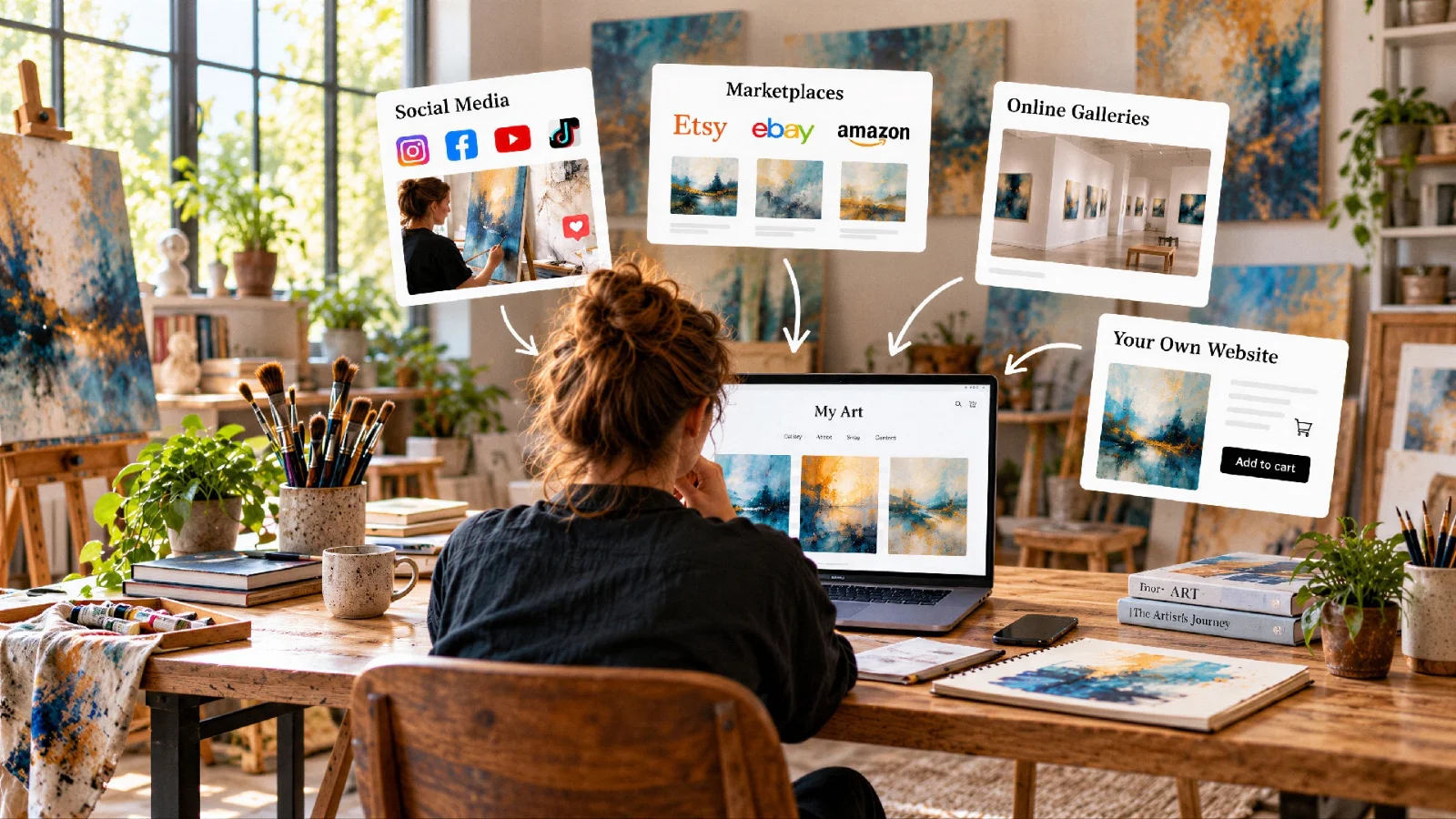
Your own website, social media, marketplaces, or online art galleries: which options should you choose to sell your work online? In this article, I share what I've learned from more than 20 years of experience and roughly 3,700 original artworks sold.
When I started selling my paintings online, toward the end of 2005, I didn't give it much thought. I chose eBay simply because it was what I knew. eBay was huge back then. I don't know if it's still as popular today, but at the time, it seemed like the obvious choice.
And it worked! That's where I made my first sales, followed by many more. All told, I sold around 700 original artworks on eBay over two or three years.
But it wasn't long before I wanted a place of my own on the internet. There were several reasons for that. One thing I'd noticed was that on eBay, my paintings were displayed alongside work by all kinds of other artists, not to mention just about every product imaginable. I figured having my own website would be different. People would be coming to my place, a space devoted entirely to my work, where I could present my paintings however I wanted and keep the competition out of the picture, at least while they were browsing my website.
And there was another reason, which makes me smile now: back in 2005 or 2006, having your own website was pretty cool! At least that's how I saw it.
So I created a website under my own name while continuing to sell on eBay. For a year or two, the two ran side by side. Little by little, my website became more important, until it turned into my main sales channel. Eventually, I stopped selling on eBay, simply because I didn't need it anymore.
Since I started, I've sold some 3,700 original artworks (not counting the editions I also offer), the vast majority through my own website.
Of course, things have changed a lot since then. Today, an artist can set up an online store in minutes, show their work to collectors around the world, or get discovered on social media without spending a dime on advertising.
The real question is what each of these options can actually do for you.
Why I Believe Every Artist Needs Their Own Website
If I were starting over today, I'd set up a website under my own name pretty early on, even if I only had a handful of paintings to show and not a single collector yet.
It wouldn't have to be anything complicated. An attractive space, good photographs, a little about my work, and a way for people to buy my paintings would already be a great start.
But to me, having your own website is about much more than putting together a nice-looking online showcase.
Getting your work noticed takes a lot of effort. If I'm spending hours making YouTube videos, posting on social media, or building a name for myself, I'm certainly not doing all that just to send interested people to a platform that will immediately show them paintings by dozens of other artists, or even products that have absolutely nothing to do with painting.
I'd much rather welcome them to my own website, where they can explore my paintings, browse my collections, and buy a piece if they want to.
And there's another reason I think this matters: on social media, we're at the mercy of the platforms' rules and decisions. I've seen people post on X about having their YouTube channels shut down, sometimes channels with huge numbers of subscribers. I don't know why those channels were closed, but I can imagine how devastating it must be to spend years building a channel only to see it disappear overnight.
With my own website, I have more control. As long as I renew my domain name, I can keep it, and I can even switch hosting providers or website platforms without losing my address. Of course, that doesn't mean nothing can ever go wrong, but at least my entire business isn't dependent on platforms that can change their rules or algorithms overnight.
There's something else I care about a great deal: my relationship with collectors.
Over the years, some people have bought several paintings from me, more than ten in some cases, sometimes years apart. Others followed my work for a long time before buying their first painting from me. After all, buying an original work of art isn't always a spur-of-the-moment decision. You might love an artist's work, follow what they're creating for months, and wait until you find the painting that really speaks to you.
With your own website, people who are interested in your work always know where to find you. They can see your latest paintings and, if they want, sign up for your newsletter to keep up with what you're doing. Over time, that helps you build a real relationship with your collectors, rather than just making a one-time sale.
And then there's the financial side. When you sell directly through your website, you avoid the sometimes hefty commissions charged by marketplaces and galleries. Of course, you still have website operating costs and payment processing fees, but on an original work of art, the difference can be significant.
Of course, having your own website doesn't guarantee you'll get visitors. You still have to get your work out there and attract people who might be interested in it.
Fortunately, artists today have some particularly interesting ways to do that.
Social Media: Getting Your Work Seen and Finding Your First Buyers
Instagram, Facebook, TikTok, and YouTube give artists opportunities that would have been hard to imagine just twenty years ago. You can share your work with people halfway around the world without necessarily going through a gallery or a selling platform.
And what I particularly like about social media is that you can share much more than finished paintings. People can see your studio, watch you paint, follow a piece as it comes together, or simply get to know your artistic world. That's quite different from an online store, where you mainly show finished works alongside their dimensions and prices.
Imagine someone comes across a video of an artist painting. They watch the piece take shape, visit the artist's profile, discover more of their work, and decide to follow them. They might not have been looking for a painting at all, but they've just discovered an artist whose work they enjoy. And sometimes that's how a relationship begins, one that leads to a sale a few weeks or months later.
That's one of the interesting things about selling art. People don't always buy a painting simply because they're looking for something to hang in their living room. Sometimes they've watched it being created, developed a connection with the artist's work, and want to own something made by someone they admire.
Social media also lets you speak directly with people who are interested. You can receive comments, answer questions, and talk to future collectors without anyone having to make an appointment at a gallery.
And sometimes, a sale happens quite naturally.
An artist posts a photo of their latest painting on Instagram. Someone messages them to ask whether it's available, asks a few questions about its size or price, and finally decides to buy it.
Great! But how are they going to pay?
The sale can happen entirely through messages, using a bank transfer or a simple payment link. So it's absolutely possible to sell paintings through social media without having an online store.
But if the artist already has their own website, it's even easier. They can just send a link to the painting. The buyer can find all the information they need and place their order at their own pace, without having to exchange a dozen messages to get every detail.
In the end, the two work together quite naturally: social media helps people discover your work and connects you with potential collectors, while your own website gives them a dedicated place to explore and buy your art, and even track their shipment afterward or leave a review.
And contrary to what you might think, you don't need tens of thousands of followers to start selling. A community of just a few hundred people who are genuinely interested in your paintings may already be enough to generate sales. Of course, having a large following doesn't guarantee buyers either. It all depends on who follows you and how interested they are in your work.
That said, don't assume posting a few pictures is enough to get noticed. Social media takes time and consistency, and the algorithms don't necessarily show every post to everyone who follows you.
But for an artist who enjoys sharing their work, social media can be much more than a communication tool. It can lead to meaningful connections with future collectors and, sometimes, account for a significant share of their sales.
Marketplaces and Online Art Galleries: Reaching New Collectors
One of the biggest advantages of selling platforms is that they can help artists connect with buyers who haven't discovered their work yet.
Unlike your own website, which you have to promote yourself, a platform already has an audience. People come to browse art, explore different categories, and sometimes discover artists they've never heard of.
That can be a real opportunity, especially when you're just starting out and don't have a customer base yet.
There are different kinds of platforms. Some are general marketplaces where you can find everything from handmade items to everyday products. Others focus entirely on art and tend to attract people interested in paintings, sculptures, or photography.
Some let almost any artist list their work, while others require an application and select the pieces they want to feature. A few online galleries also offer sales support, with advisors who can speak with collectors or help close a sale.
Each approach has its benefits. A general marketplace might have enormous traffic, while a specialized gallery might attract a smaller audience that's particularly interested in art.
But here's an important question: out of all those visitors, how many will actually come across your paintings?
Because a platform's overall traffic isn't the same as traffic to your own listings. A website can get millions of visitors without many of them ever looking at your work.
A lot depends on how the platform displays it. Some pieces will appear in search results, others in recommendations, curated collections, or advertising campaigns. And when thousands of artists are competing for attention, getting noticed can take just as much work as it does on your own site.
I've seen this firsthand with my stencil businesses.
During the first few weeks after launching our own websites, we were already getting far more visitors from organic Google search than our Etsy shop had received through Etsy's internal search during its first few weeks.
And we did that without spending a dime on Google ads.
Of course, we'd put serious work into search engine optimization (SEO) from the moment we launched our sites. On Etsy, on the other hand, we found it harder to get that kind of organic visibility and eventually started paying for ads.
That doesn't mean Etsy doesn't work, or that attracting visitors from Google is always easier. It's simply our experience, and it helps explain why I'm cautious about the traffic figures big platforms like to highlight.
Actually, I think a smaller gallery can sometimes be a great opportunity. If it attracts collectors who genuinely appreciate the kind of art you make, it can be worthwhile even with a relatively modest audience.
Likewise, just because a gallery selects its artists doesn't automatically mean it'll actively promote every piece they make. Getting accepted and getting real exposure are two different things.
To me, what matters is understanding what a platform can genuinely do to get your work in front of new buyers, and what, if anything, it does to help make sales.
Selling in Multiple Places: A Good Idea, but Watch the Workload
On paper, listing your work in several online galleries sounds like a great idea. Why limit yourself to one platform when others could help you meet new collectors and make additional sales?
But personally, there's one thing that really holds me back: all the work involved in being present on multiple platforms.
Every time you want to join a new gallery, you usually have to create an account, fill in your background, put together your artist bio, and then start listing your work. Upload photos, enter titles, write descriptions, specify dimensions, mediums, prices, shipping details... And if you want to try a second or third platform, you have to do it all over again.
And that's not all! If you also want your artwork pages to show up in Google search, it's best not to copy and paste the exact same descriptions across every platform. Google may treat these pages as duplicates and choose to favor just one of them in its results. And there's no guarantee it'll pick the page on your own website! It could just as easily show the gallery listing instead, sending visitors to that platform rather than to you.
To reduce that risk, ideally you'd tailor each artwork description to the platform where it's published. Even more work just to showcase the exact same paintings!
With five or ten paintings, it's still fairly manageable. But imagine an artist with fifty available pieces who wants to list them in four different galleries. That's up to two hundred listings to create, each with all the information that goes with it!
And the most frustrating part is that you have to do all that work before you even know whether any of those galleries will bring you a single sale.
Then there's the day-to-day management, with one extra complication when you're selling original artwork: every piece is one of a kind.
If a painting is listed on your own website and several galleries, you have to remember to remove it everywhere else as soon as it sells. Otherwise, you could end up with two orders for the same one-of-a-kind piece. You also have to keep prices updated, add new work, and make sure each catalog stays accurate.
In the end, what was supposed to give you more chances to sell can quickly turn into a mountain of administrative work.
And then, of course, there are the commissions.
Some galleries take as much as 50% of the sale price. That's a lot! On a painting sold for €1,000, the artist is left with just €500, before any other expenses. So you have to make sure what's left is still worth the time, materials, and work that went into creating the piece.
And that's not the only cost to consider. Even a high commission is only charged if you actually sell a painting. But uploading your work and keeping all those listings updated takes time, whether you sell anything or not. Not to mention the subscription fees some platforms charge, regardless of sales.
Despite all that, I still believe there's value in offering your work in more than one place. If a gallery helps me sell a painting to a collector I wouldn't have met otherwise, that's a great thing.
What I find frustrating is having to spend so much time repeating the same tasks just to give my paintings a better chance of being discovered.
After all, we're talking about the same artwork, the same photos, the same dimensions, and the same descriptions. Why should we have to do all that work over and over again?
Khroma: A Ready-to-Use Artist Website, Plus an Online Gallery
After more than twenty years of selling my paintings online, and several years building ecommerce stores, I know firsthand how much work goes into creating and managing an online shop. That experience is a big part of what inspired me to create Khroma.
Because there's something I've always found a little frustrating: when an artist wants to sell through their own website, they often have to start by learning how to build and run a website. Choose a theme, organize the pages, set up the store, configure payments, figure out SEO... All of that can quickly turn into a major project, when all they really want to do is show and sell their work.
With Khroma, I wanted to approach things the other way around: the website is already built, and everything has been designed specifically for artists.
Artists don't have to figure out which pages they need, how to organize their gallery, or how to display their paintings. The structure is ready to go, with a homepage, an artist bio, their artwork, and everything needed to offer pieces for sale. They can customize the site, use their own domain name, and focus on what they want to show rather than how to build the site itself.
But I also wanted to make another task easier, one that takes an enormous amount of time when you have a lot of work to share: listing your artwork.
Taking photos of a painting is one thing. Writing its description, filling in its details, and preparing the text needed for search engines is another. And when you have thirty or fifty paintings to upload, that can quickly turn into hours of work.
On Khroma, AI can analyze photos of an artwork and suggest a title, description, and SEO content, including image alt text. The artist can then review, edit, or add to those suggestions before publishing. They stay in control, but no longer have to write everything from scratch.
And Khroma isn't just about giving artists their own websites. We've also created the Khroma Gallery, an online gallery where visitors can discover work by different artists.
Here's how it works. Any artist can create their own website with Khroma, with no application or selection process. But if they also want to show their work in the Khroma Gallery, they need to apply and be accepted.
Once approved, they can choose which paintings from their own site they want to offer in the gallery as well. And here's the interesting part: they don't have to publish anything a second time. The photos, descriptions, and other details are already stored in Khroma.
The same painting can therefore be available on both the artist's website and in the Khroma Gallery without the artist having to manage two separate listings. And when it sells, whether on their site or through the gallery, it's automatically marked as unavailable in both places.
We also decided not to charge the same commission on sales made directly through an artist's website as on sales made through the Khroma Gallery.
An artist website costs €39 per month, excluding VAT, with a 1% commission on direct sales, excluding VAT and payment processing fees. When a piece is sold through the Khroma Gallery, the commission is 30%, excluding VAT.
Artists can grow their direct sales through their own websites while also having the option to reach new collectors through the gallery. And most importantly, without having to manage two separate catalogs.
By the way, I use Khroma for my own artist website. So I'm not just the person behind the idea, I'm a user, too. And that's valuable for our team: my experience as an artist helps us see what works, what could be better, and what artists really need Khroma to do.
I didn't create Khroma to teach artists how to run websites. I created it so they wouldn't have to, and to give them more time for what really matters: their art.
So, Where Should You Sell Your Art When You're Starting Out?
With so many options, I understand why an artist might not know where to start. But if I had to start over from scratch today, I already know what my first move would be: build my own website.
Even if I only had a few paintings and not a single collector, I'd want a place under my own name where I could show my work and let interested people buy it. Nothing complicated at first, just a foundation I could build on over time.
Then, of course, my priority would be getting my paintings seen. Because having a website is great, but people still need to find it!
If I were starting with no audience at all, I'd probably choose one or two social media platforms I feel comfortable using to show my work. I'd also look into marketplaces and galleries that might help me connect with my first buyers.
But I wouldn't spend weeks creating accounts everywhere. Before joining a gallery, I'd take a good look at the art it features, the audience it serves, and how it promotes its artists. If my work seems like a good fit, why not give it a try?
On the other hand, if I already had a following on social media and was regularly getting inquiries about my paintings, my priorities would be a little different.
First, I'd make it easy for people who are already interested in my work to buy it. Having a website with a way to pay online would be an immediate priority. Then I could consider joining a few galleries to reach new collectors, without having to hand over the sales I was already making directly.
You also have to think about your own personality and what you enjoy doing. Some artists love sharing videos of their creative process, chatting with followers, and handling their own sales. Others would rather spend more time in their studios and let galleries take care of some of the selling.
And I don't see why everyone should have to do the same thing. If you hate being on camera, there's no reason to force yourself to post daily videos just because it's trendy. Thankfully, there are other ways to get your work noticed.
Finally, I think it's important to give the channels you choose a little time while keeping an eye on what they actually bring you.
A gallery that sells a few of your paintings each year and requires very little work from you could be well worth it. On the other hand, a platform that makes you spend several hours a week updating your listings without ever bringing you buyers may deserve less of your attention.
It's not necessarily about finding the channel that generates the most sales. It's about finding the ones that work for you, with the time and resources you have.
And above all, I wouldn't try to come up with the perfect strategy from day one. I'd start with my website, a few pieces to show, and one or two ways to help people discover them. Then I'd adjust as I made my first sales, met new people, and came across new opportunities.
More than twenty years later, that's still how I approach things. The way I sell my paintings has changed a lot since my early days on eBay, and I'm sure it'll keep changing. So I'd be the last person to tell you there's one perfect solution you can pick once and never have to think about again!
Read next
How to Price Your Artwork
How to build a consistent pricing structure, set your first prices, and adjust them as your market develops.
Sell Your Art Online: The Complete Guide for Artists
After twenty years and roughly 3,700 artworks sold, I share what I’ve learned about selling art online: pricing your work, choosing where to sell, finding buyers, presenting your art, and shipping it.
Khroma ·
Khroma launches its blog
Guides, insights and resources for artists and collectors, covering art, visibility, selling, collecting and the evolution of Khroma.